Why effective leadership depends less on having one style - and more on reading the moment.

Hey, it’s Rafic.
Welcome back to Peak Performance Insider.
Two leaders can handle the same situation completely differently—and both can be right.
One may step in, give direct instructions, and make the decision.
The other may slow down, ask questions, and let the employee work through it.
Which one is leading correctly?
It depends.
Is there an immediate operational risk?
Is the employee experienced or still learning?
Is the objective to solve the problem quickly—or develop the person for the future?
Leadership becomes difficult when we try to turn it into a fixed set of rules.
- Be empathetic.
- Hold people accountable.
- Give people autonomy.
- Be decisive.
- Listen before acting.
All of these principles can be useful.
None of them work equally well in every situation.
The real skill is knowing what this moment requires from you.
📌 Today’s Agenda
✅ Why there is no single “correct” leadership style
✅ The difference between consistency and rigidity
✅ How to balance trust, accountability, people, and performance
✅ Four questions to ask before deciding how to lead
First time reading?

✍️ Deep Dive: The Situation Changes the Leadership Required
Leadership advice is often presented in absolutes.
A good leader empowers people.
A good leader listens.
A good leader is empathetic.
A good leader holds high standards.
But leadership becomes more complicated when those principles begin competing with one another.
Should you listen longer—or make the decision?
Should you show patience—or address the issue directly?
Should you give the person another opportunity—or increase the level of accountability?
Should you trust them—or verify the work?
There is rarely one answer that applies every time.
The better question is not:
“What would a good leader normally do?”
It is:
“What does this person, situation, and objective require from me right now?”
The Same Approach Will Not Work Everywhere
Consider how the right response changes depending on the situation.
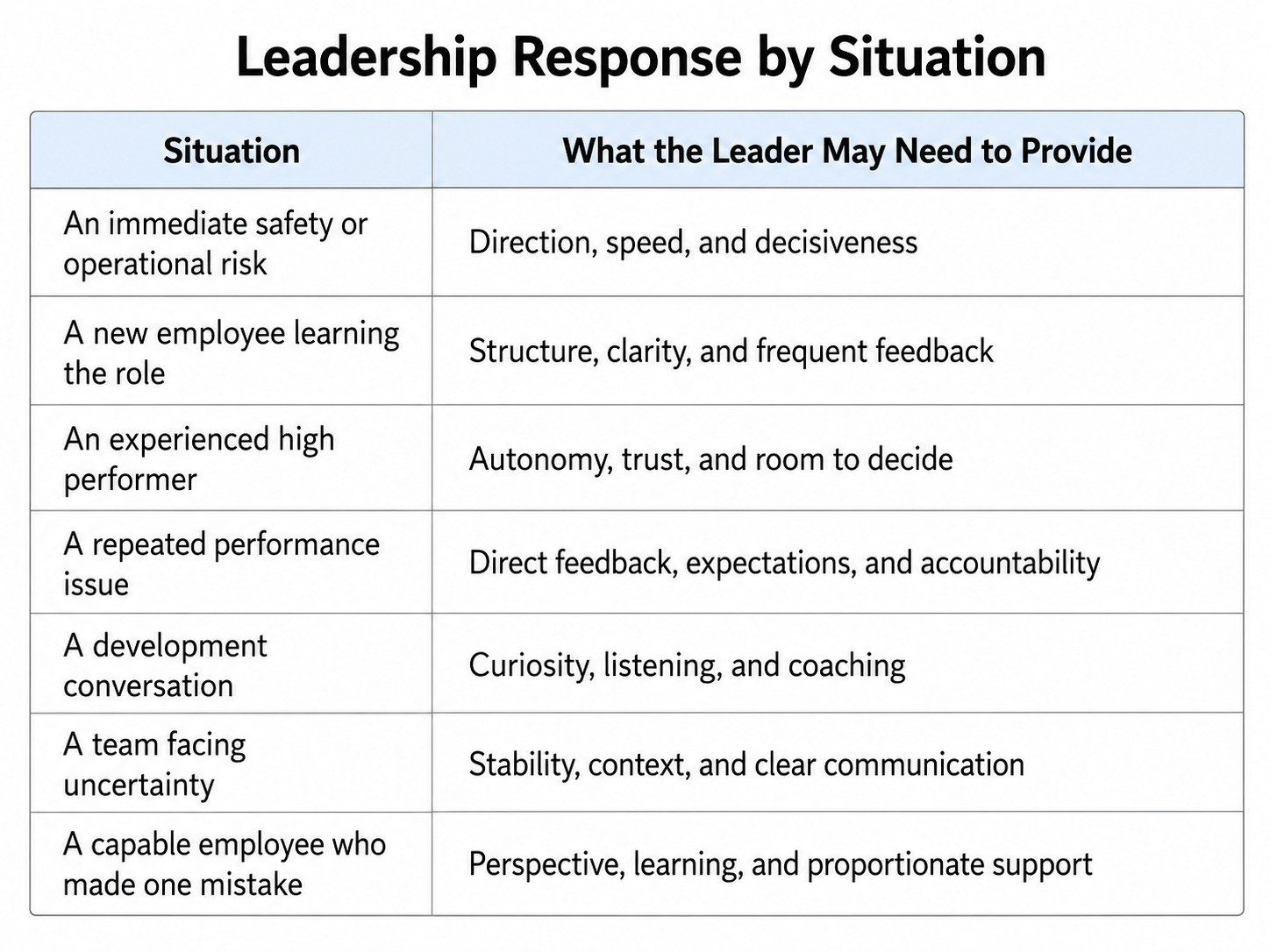
That is not inconsistency.
That is judgment.
Consistency Is Not the Same as Sameness
Leaders sometimes worry that changing their approach will make them appear inconsistent.
But consistency does not mean:
- Giving everyone the same amount of direction
- Responding to every mistake in the same way
- Using the same communication style in every conversation
- Treating every situation as though the stakes are equal
Consistency means your principles remain steady, even when your approach changes.
For example:
You can consistently value accountability while giving a new employee more patience than an experienced manager.
You can consistently value trust while verifying work that carries significant financial, safety, or customer risk.
You can consistently care about people while still addressing poor performance directly.
You can consistently invite input while making the final decision when time is limited.
The principle remains stable.
The application changes.
Leadership Means Managing Competing Truths
Many leadership problems are not choices between right and wrong.
They are tensions between two ideas that are both partly right.
Be confident, but remain open to being wrong.
Trust people, but verify critical work.
Move quickly, but do not ignore important information.
Hold high standards, but allow people room to learn.
Listen carefully, but do not delay necessary decisions.
Care about people, but do not avoid difficult conversations.
Empathy without accountability can become permissiveness.
Accountability without empathy can create fear.
Autonomy without clarity can create confusion.
Control without trust becomes micromanagement.
The goal is not to choose one side permanently.
It is to recognize which side needs greater emphasis in that particular moment.
Results Matter. So Does Trust.
Leadership ultimately has to produce two outcomes:
Results and trust.
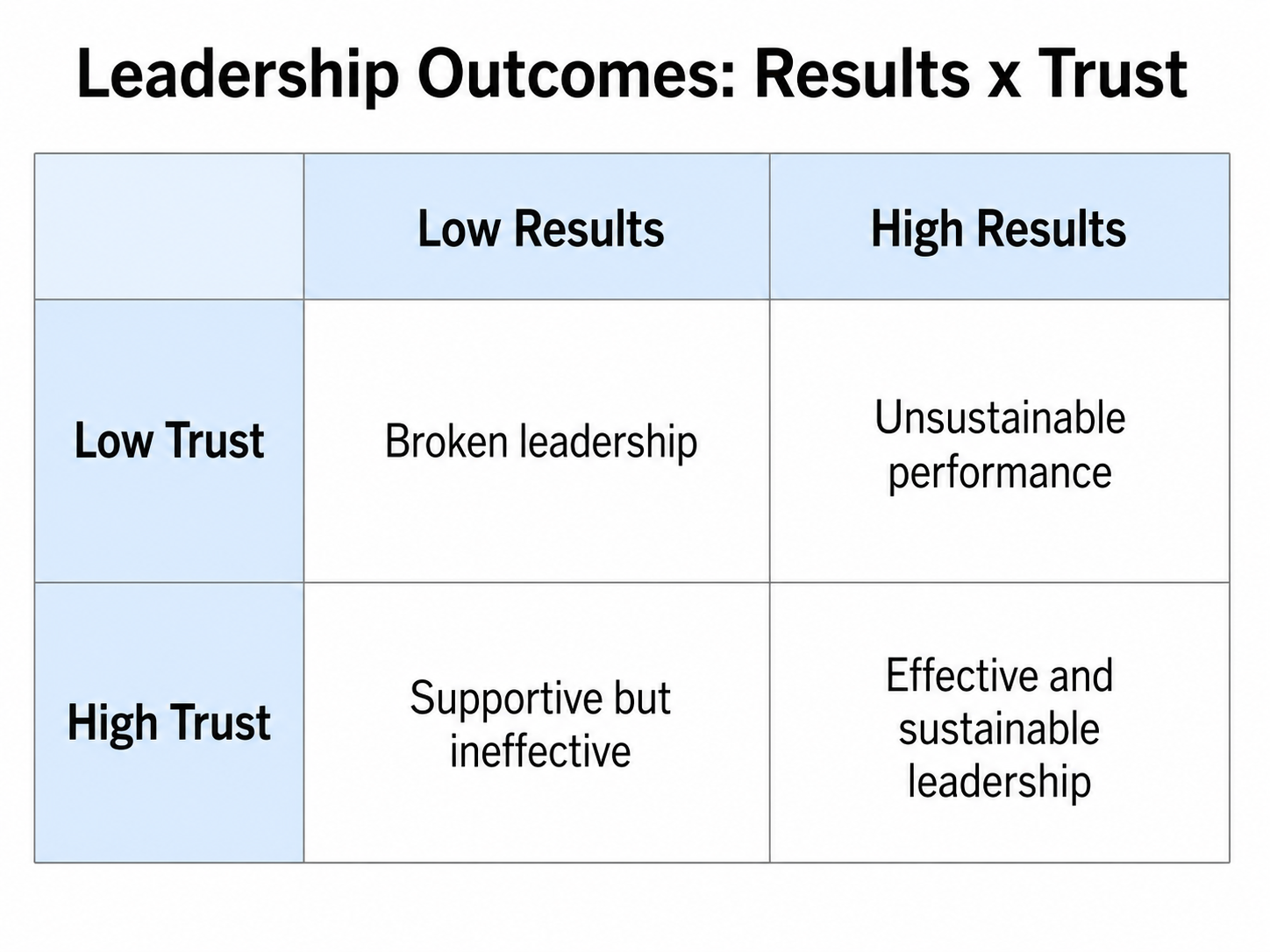
A leader may achieve strong numbers through pressure, fear, and constant control.
That can work temporarily.
But the hidden costs eventually appear:
→ Burnout
→ Silence
→ Low ownership
→ Turnover
→ Dependence on the leader
Another leader may create a supportive environment where everyone feels comfortable, but expectations remain unclear and poor performance goes unaddressed.
That also fails the team.
People deserve both:
A workplace where they are respected and trusted.
And leadership that provides clarity, standards, and accountability.
The goal is not to choose between people and performance.
The goal is to build performance through people.
Before You Respond, Diagnose the Moment
When you are unsure how to lead, pause and ask four questions.
1. What are the stakes?
Is this a moment for discussion—or does the situation require an immediate decision?
High-risk and time-sensitive situations usually require more direction.
Low-risk situations often create better opportunities for coaching and ownership.
2. Who is in front of me?
What is this person’s level of experience, confidence, and capability?
Someone who is learning may need more guidance.
Someone who has demonstrated strong judgment may need you to step back.
Do not give autonomy before someone has clarity.
But do not keep giving direction after someone has earned trust.
3. What outcome am I trying to create?
Are you trying to:
→ Resolve an immediate problem?
→ Correct a repeated behaviour?
→ Develop someone’s judgment?
→ Restore trust?
→ Increase ownership?
→ Protect a standard?
The right approach depends on the result you are trying to create.
4. What does this situation need more of?
More clarity?
More challenge?
More patience?
More urgency?
More autonomy?
More accountability?
Leadership improves when you stop reacting from your default style and start responding to what is missing.
One Question Worth Sitting With
Think about a recent leadership decision that did not go as well as you hoped.
Then ask:
Did the situation require a different version of my leadership than the one I naturally prefer to use?
Sometimes the problem is not that your leadership style is wrong.
It is that you used the right style in the wrong moment.
🤝 Work With Me
Leadership decisions rarely come with perfect information.
You are constantly balancing people, performance, urgency, trust, expectations, and consequences—often while the situation is still unfolding.
Coaching gives you a place to step back from the immediate pressure and examine how you are leading:
What is working?
What are you avoiding?
Where are you overcorrecting?
And what might the situation require from you now?
The goal is not to give you a leadership formula.
It is to help you develop the judgment to lead more intentionally when the answer is not obvious.
Learn more:
👉 https://www.raficosseiran.com 🚀
🔗 Best Links - My Favorite Finds
A few things I came across this week on growth, leadership, productivity, and well-being.
🧠 Personal Growth & Mindset
🔹 How High Performers Navigate Personal Crises Without Losing Momentum| A perspective on staying grounded, adjusting expectations, and continuing forward when life becomes difficult.
👥 Leadership & Influence
🔹 Want to Be a Leader? You Can No Longer Rely on Technical Expertise | Technical ability may help you earn greater responsibility, but leadership requires a different set of capabilities.
📈 Habits & Productivity
🔹 Highly Productive People Block Off This Hour Daily, According to Career Coaches | A practical reminder that protecting time to think can be just as important as protecting time to execute.
💪 Health & Wellness
🔹 How to Stop Sabotaging Yourself and Commit to Your Goals | A useful look at why people struggle to fully commit to meaningful goals—and what helps turn intention into action.
🎯 That's a Wrap
There is no single right way to lead every person in every situation.
Sometimes people need encouragement.
Sometimes they need clarity.
Sometimes they need space.
Sometimes they need to hear something uncomfortable.
Effective leadership is not about changing your values every time the situation changes.
It is about keeping your principles steady while adapting how you apply them.
The best leaders do not memorize the right response.
They develop the judgment to recognize what the moment requires.
See you next week.
— Rafic Osseiran
🗳 How did you like today's newsletter? Click an image below to share your thoughts!


(Or just hit reply and let me know!)